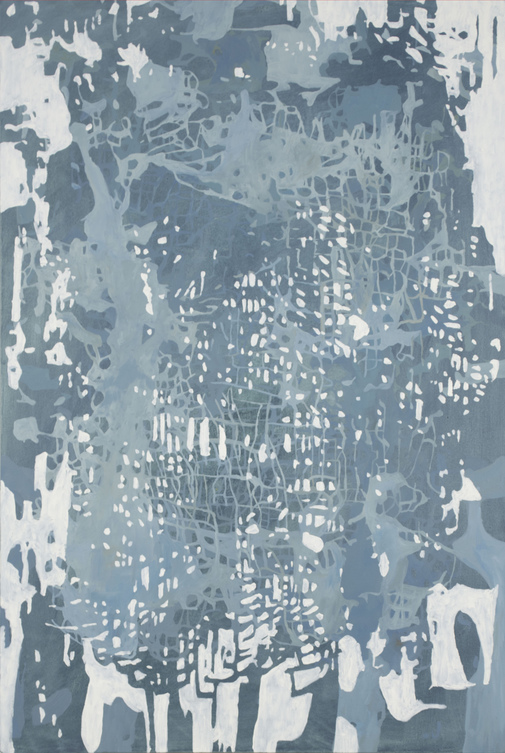
| Iteration, Alteration Iteration in my work revolves around the idea that every repetition is an alteration, yet where the alteration differs without changing into something that does not contain the trace of the original. The term trace is Derrida’s and refers to what belongs to the degree of difference by which an alteration is inscribed. So at a base level a trace is the very registration of alteration, but always contains an intimation of the deferral from the original and an implicit continuous associative attempt to reunite with what was altered. To explore this relationship, I begin with the same original drawing which is repeated multiple times in each painting and each time in different ways. Of course in doing this, I am interested in the impossibility of the repetition of the source or of the same. But additionally, and maybe more importantly, I am interested in the relations between iterations. How do they connect and represent a trace of the original while simultaneously pointing to its absence. It is in this exploration of difference, similarity, and absence that I hope to present perceptual metaphors of the nearest phenomenal difference/deferral/trace that we experience and that is the incommensurability of ourselves to ourselves. It is my philosophical viewpoint that being a ‘self’ is iterative, much like my repeated morning ritual of meeting the mirror and thinking, “Oh it’s you …again.” Concomitantly if I repeat, then I must in that repeating be altered or changed. The incommensurability comes into play when I try to access the original or to relate myself to my younger self, since I am only a trace, in other words, how I stay the same or differ over time is ultimately not capable of measurement. Now of course the paintings are non-objective and certainly do not illustrate this relationship. The hope is to give the opportunity to experience perceptually a metaphorically similar experience. In each work I have made specific formal choices that seek to disallow or at least make more complex the perception of the gestalt of the paintings. To experience a gestalt of an art work is to see it as an integrated whole, to see it all at once, and subsequently to allow the experience of a memory image or to hold it in your minds eye. So what does it mean to not be able to integrate the parts to the whole, to not be able to hold it in your mind’s eye, to not be able to access the original source, yet still see or recognize an elusive order that is seen through the relation of differences? Phillip Buntin |
||